

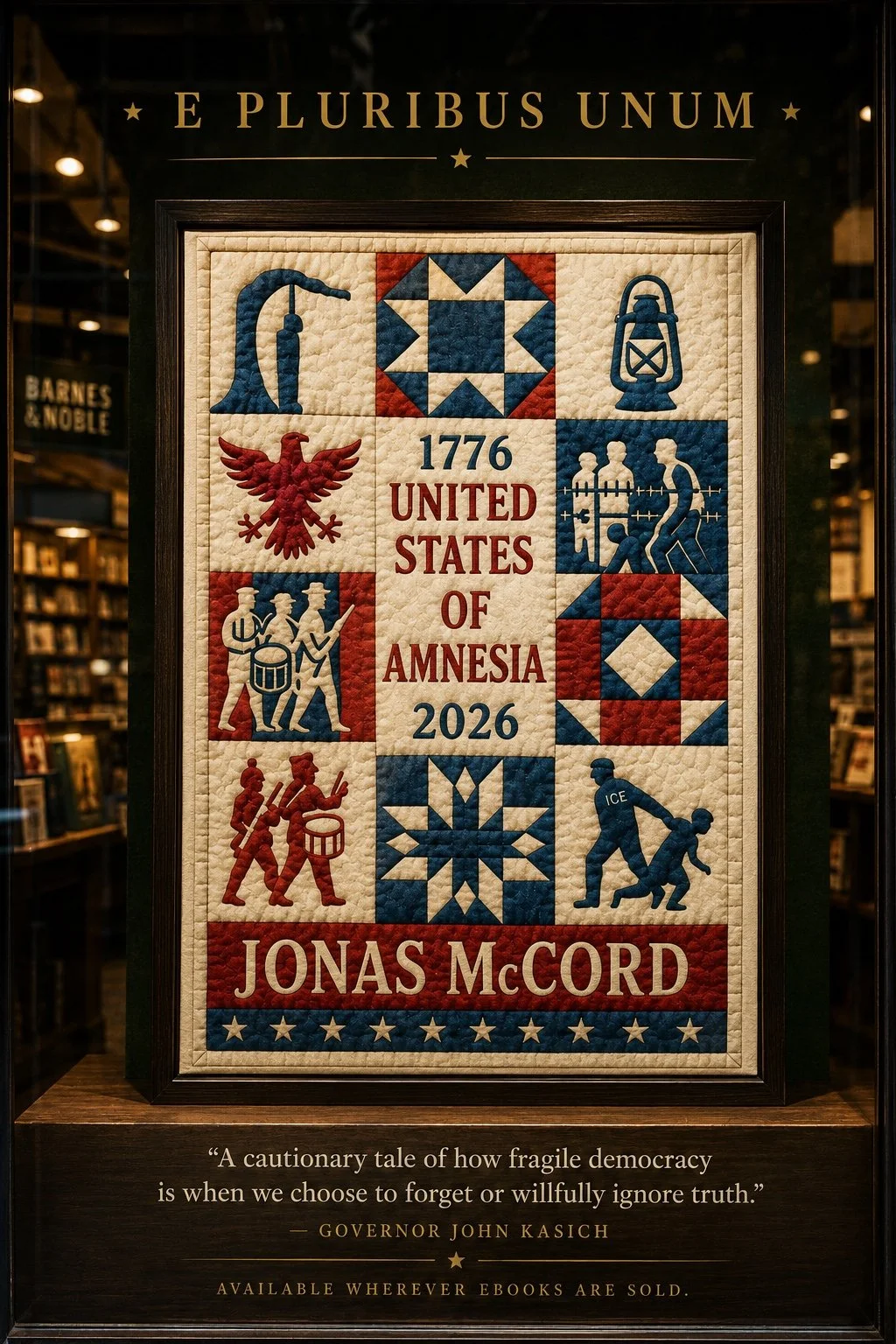
Advanced Media Kit
THE UNITED STATES OF AMNESIA
True Stories America Wants to Forget
Jonas McCord

About the Book
Why the Book Matters
The United States of Amnesia tells the story of America not through presidents or politicians, but through the lives of ordinary people who experienced the defining moments of our history.
Spanning more than four centuries, the book is built around eighty first-person testimonies. Each chapter pairs two opposing voices-one who suffered injustice and one who challenged it-revealing the continuing struggle between America's highest ideals and its deepest contradictions.
Not written as a partisan argument, the book invites readers to confront the past in all its complexity and to ask how a nation remembers, forgets, and ultimately defines itself.
Told through eighty first-person historical narratives.
Covers more than four centuries of American history.
Explores forgotten stories that continue to shape the present.
Pairs every injustice with someone who stood against it.
Written by an award-winning storyteller whose work has spanned more than four decades in film and television.

For Immediate Release
Award-Winning Filmmaker and Author Jonas McCord Releases The United States of Amnesia, a Sweeping New History Told Through the Voices of Ordinary Americans
LOS ANGELES, California - The United States of Amnesia: True Stories America Wants to Forget examines more than four centuries of American history through eighty
first-person historical testimonies, allowing readers to experience the nation's defining moments through the voices of those who lived them rather than through politicians or textbooks.
Rather than tell readers what to think, the book invites them to listen-to the enslaved, immigrants, Native Americans, soldiers, suffragists, labor organizers, civil rights pioneers, and ordinary Americans whose lives shaped the nation's story.
At a moment when Americans are debating how history should be remembered, taught, and presented, The United States of Amnesia offers a different approach. It presents history through lived experience, pairing stories of injustice with the stories of those who chose to confront it.
Jonas McCord is a dual Emmy, Peabody, and Special Academy Award-winning screenwriter, producer, director, and author whose work in film and television has spanned more than four decades. The United States of Amnesia represents the culmination of years of research into the people and events that continue to shape America's national identity.
Governor John Kasich wrote of the book:
"Jonas McCord is a gifted storyteller. In The United States of Amnesia, McCord tells the story of America through the lives of those willing to walk the lonely road-to confront injustice, acknowledge our original sins, and move the nation forward. It is also a cautionary tale about how fragile democracy becomes when truth is forgotten, ignored, or denied."

Synopsis
The United States of Amnesia is a work of narrative nonfiction that explores the American experience through the stories history chose to forget.
Rather than recounting history through presidents, generals, and political movements, the book tells the American story through the voices of ordinary men and women whose courage, suffering, sacrifice, and resilience helped shape the nation but rarely found a lasting place in its collective memory. Told through eighty first-person testimonies spanning more than four centuries, each chapter pairs opposing voices-victim and witness, oppressor and dissenter, idealist and pragmatist-to illuminate not only what happened, but why those events continue to shape America today.
From the nation's founding to the present day, The United States of Amnesia explores race, immigration, religious freedom, women's rights, labor, war, justice, and democracy-not as isolated episodes, but as chapters in an ongoing struggle to fulfill the promise of the American experiment.
The book is neither an indictment of America nor a celebration of it. It is an invitation to remember it.
Through meticulously researched historical narratives and first-person testimony drawn from or carefully shaped by documented events, the book argues that democracies cannot preserve what they choose to forget. Forgotten history does not disappear; it returns, often disguised as today's crisis.
Ultimately, The United States of Amnesia is about memory, conscience, and redemption. It asks readers to confront America's deepest contradictions alongside its greatest acts of courage, suggesting that the nation's true strength lies not in the myth of perfection, but in its enduring capacity for honesty, self-examination, and renewal.
Methodology / Sourcing Note
The United States of Amnesia is grounded in documented historical events and supported by an extensive bibliography. Many of the first-person voices are drawn directly from letters, diaries, speeches, memoirs, testimony, court records, newspaper accounts, and other historical documents. Where no complete first-person account exists, the narrative voice has been carefully shaped from documented evidence to remain faithful to the historical record.
Why This Book. Why Now
"I did not write this book because I wanted to. I wrote it because I had to." - Jonas McCord
America has always struggled with its past. But today, that struggle has become something larger.
Across the country, the stories we tell about ourselves-what belongs in classrooms, museums, public memorials, and national conversations-have become subjects of intense debate. History itself has become part of the culture war.
The United States of Amnesia enters that conversation from a different direction.
It is not written to condemn America. Nor is it written to celebrate America uncritically.
It asks a simpler question:
What happens to a democracy when it begins to forget the people who paid the price for making it better?
Through eighty first-person historical testimonies, the book gives voice not only to those who suffered injustice, but also to the men and women who risked everything to confront it. Every story of darkness is paired with a story of courage. Every wound is paired with someone who chose to stand against it.
The result is not a political argument. It is a human one.
The book's central premise is simple:
A nation cannot become what it was meant to be by forgetting how it became what it is.
The foreword says it best:
"I wrote this because I am tired of pretending we are better than we are. And I still believe we can be. But not without remembering what we have done."


Why I Wrote This Book
I did not write this book to condemn America.
I wrote it because I believe America is more than the worst things we have ever done. Throughout our history, the identity of "the other" has constantly changed. Black.
Native American. Irish. Chinese. Jewish. Japanese. Catholic. Immigrant. One generation after another, someone new has been pushed to the margins.
But that is only half of our story.
The other half belongs to the ordinary Americans who refused to stand by. In every chapter of this book, there is someone who chose courage over comfort, conscience over silence, and justice over fear. They were rarely the powerful. Most were ordinary citizens who simply decided another human being should not stand alone.
That is why I still have faith in this country.
Not because we have always lived up to our ideals-but because, generation after generation, ordinary Americans have sacrificed their freedom, their livelihoods, and sometimes their lives to help us become a better nation.
This book is dedicated to them.
History is not simply a record of our failures. It is also a testament to the people who refused to accept them.
That is why I wrote The United States of Amnesia. Because I still believe in the promise of We the People.
- Jonas McCord

Featured Chapters
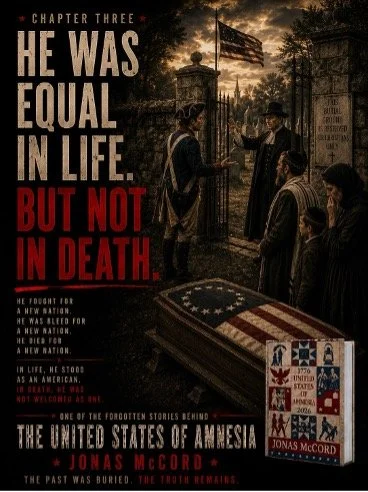
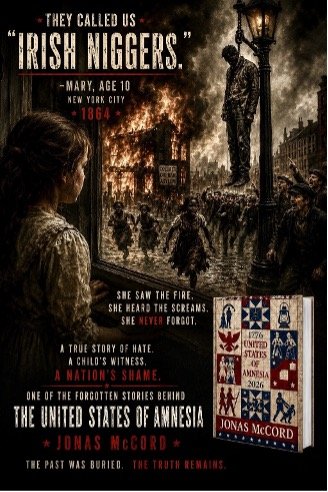
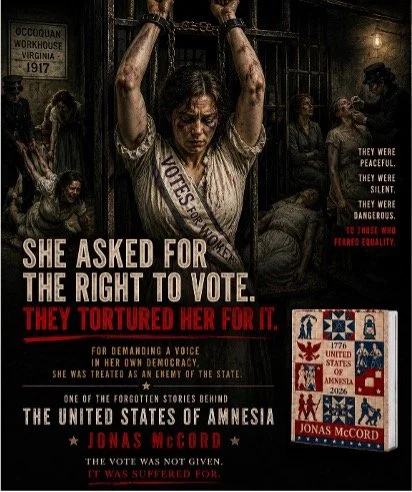
He Was Equal in Life. But Not in Death.
Revolutionary War - Religious Freedom
A Jewish patriot, financier of the American Revolution, and prisoner of war helped sustain the fight for independence. Even though George Washington himself affirmed that America should give "to bigotry no sanction, to persecution no assistance," when this patriot died, the nation he helped create could not let him lie with the men he had bled with.
One of the earliest contradictions between America's founding ideals and its practice.
1863-1864 - The New York Draft Riots
New York City exploded in what remains one of the deadliest civil disturbances in American history. Many working-class Irish immigrants, unable to afford the $300 commutation fee that allowed wealthier men to avoid military service, saw themselves as being forced to die in a war from which the rich could buy their escape. Their anger, fueled by political manipulation, economic fear, and racial hatred, was turned against Black New Yorkers. Innocent men were lynched in the streets. The Colored Orphan Asylum was burned, sending children fleeing for their lives. Through the eyes of ten-year-old Mary, this chapter explores how injustice against one people can be manipulated into violence against another-and why America has largely forgotten one of its darkest weeks.
1917-1919 - The Fight for Women's Suffrage
For generations, American women were expected to obey the laws of a nation that denied them a voice in making those laws. When suffragists peacefully demanded the right to vote, many were arrested, imprisoned, beaten, force-fed, and tortured for refusing to surrender their cause. Their determination helped transform American democracy-not because freedom was given to them, but because they refused to stop demanding it. Their story reminds us that every right we inherit was first won by someone willing to suffer for it.
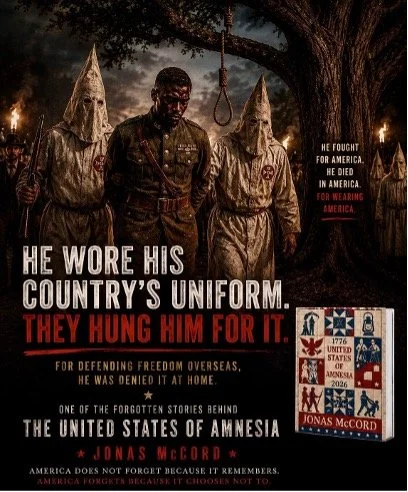
1945-1955 - He Fought for America. They Hung Him for It.
He wore his country's uniform in defense of freedom overseas. He returned home believing he had earned the rights of every American citizen. Instead, he was met with hatred, terror, and a lynch mob determined to remind him that, in their eyes, his military service changed nothing. This chapter tells the true story of a decorated Black veteran whose courage on the battlefield could not protect him from racial violence at home. It asks a haunting question: What does freedom mean if the nation you fought to defend refuses to defend you?
One of the forgotten stories behind America's unfinished promise of equality.